
Downsizer Contribution: How to Boost Super Without Hurting Your Pension
If you’re over 55 and thinking about selling your home, the downsizer contribution could be one of the most powerful retirement strategies available.
It allows you to move up to $300,000 per person (or $600,000 per couple) from your home into superannuation—without the usual contribution limits.
But there’s a catch: if done incorrectly, it can reduce or eliminate your Age Pension.
This guide explains exactly how it works, who it suits, and how to use it safely.
What Is the Downsizer Contribution?
The downsizer contribution is a special superannuation rule that allows Australians aged 55 or older to contribute proceeds from selling their home into super.
Key features:
Up to $300,000 per person
Available to couples ($600,000 combined)
Does not count toward normal contribution caps
No work test required
This strategy effectively allows you to convert property wealth into retirement income.
👉 For a deeper look at how downsizing itself impacts your pension, see
Selling the Family Home: Impact on Age Pension and Alternatives
Who Is Eligible?
To qualify, you need to meet strict criteria:
Basic eligibility:
Aged 55 or older
Owned the property for at least 10 years
The home qualifies for CGT main residence exemption
Contribution made within 90 days of settlement
👉 Downsizer contributions are typically a once-in-a-lifetime opportunity, so planning matters.
How the Downsizer Contribution Affects Your Age Pension
This is where most Australians go wrong.
The biggest misconception is:
“If I put the money into super, it won’t affect my pension.”
That is NOT true after Age Pension age.
Assets Test Impact
Once funds enter super AND you are of pension age:
The amount becomes assessable under the assets test
It can reduce or eliminate your pension
👉 Learn how this works in detail:
Assets Test Explained (2026 Guide)
✅ Example:
Sell home → $600K surplus
Move $600K into super
Your assessable assets increase significantly
Pension may reduce or stop
Income Test and Deeming
Centrelink doesn’t look at actual returns.
Instead, your assets are deemed to earn income, which affects the income test.
👉 Detailed breakdown here:
Income Test Explained (2026 Guide)
Key Rule – The Lowest Pension Applies
Centrelink uses both tests, and whichever gives the lower result applies.
👉 Read more:
Income vs Assets Test – Which Matters More?
How to Use the Downsizer Contribution Strategically
Used correctly, this strategy can:
Improve cashflow
Increase tax efficiency
Maintain or even improve your Age Pension
Strategy 1 — Timing Your Contribution
After selling your home:
Proceeds intended for your next home can be exempt for up to 12 months (or longer in some cases)
This creates a critical planning window.
Strategy 2 — Don’t Put Everything Into Super
Many retirees assume they should maximise contributions.
That’s often a mistake.
Instead consider:
Keeping some cash outside super
Paying off debt
Spending on exempt assets
👉 More ideas:
Can I Spend My Money and Increase My Age Pension?
Strategy 3 — Use the Family Home Advantage
Your home is exempt from the assets test, but cash is not.
👉 Understand this critical difference:
How the Family Home Affects Your Age Pension[agepension...ces.com.au]
Strategy 4 — Combine with Other Asset Strategies
The downsizer contribution works best alongside:
Super structuring
Asset repositioning
Gifting strategies (within limits)
👉 Learn more:
How to Reduce Assets for Age Pension Eligibility
Before you sell your home or make a downsizer contribution, it’s critical to model the impact properly.
Even small structuring changes can mean the difference between:
Keeping a full pension
Losing tens of thousands per year
👉 Book A Consultation Today
Downsizer Contribution vs Other Super Contributions
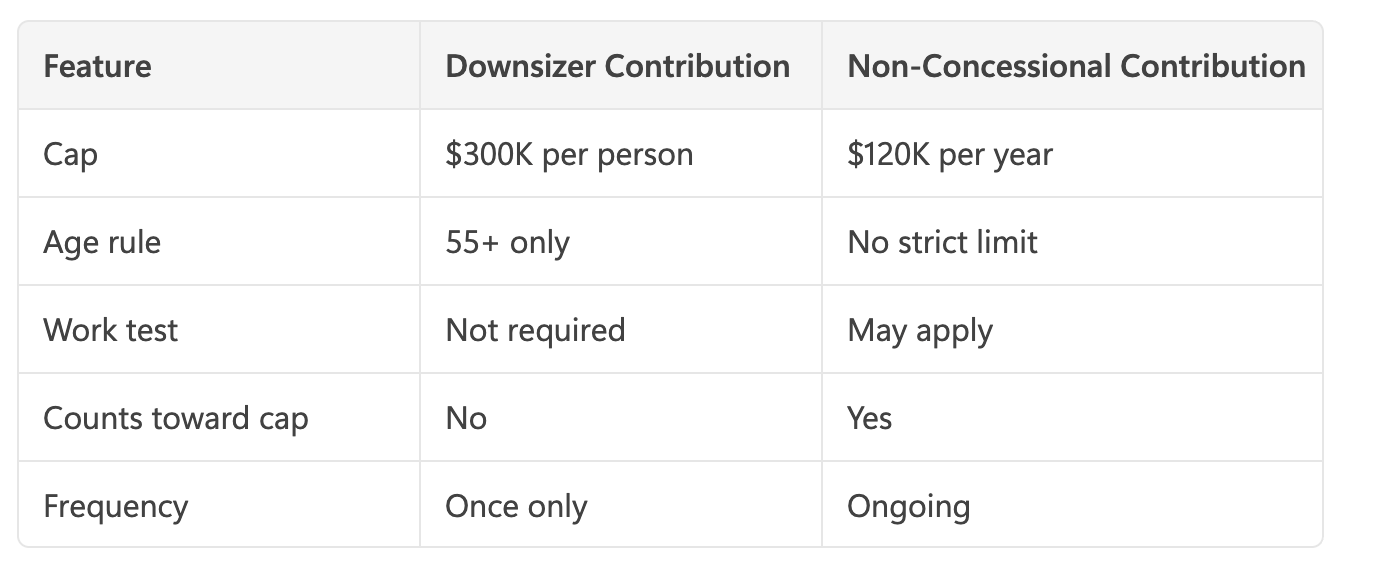
👉 Downsizer contributions are unique because they bypass normal restrictions.
Real-Life Example
John and Mary (Age 68)
Home sold: $1.2M
New home: $700K
Surplus: $500K
They:
Contribute $300K each into super
Total: $600K added
Result:
Super increases significantly
Assets test kicks in
Age Pension reduces
👉 As explained here:
Using the Downsizer Contribution Without Losing Your Pension
With proper structuring, however, the outcome could have been improved.
Benefits of Downsizer Contributions
✅ 1. Boost Super Quickly
Convert home equity into liquid retirement assets.
✅ 2. Tax-Effective Investing
Super earnings taxed up to 15% (or 0% in pension phase).
✅ 3. No Contribution Limits
Does not affect standard caps.
✅ 4. Simpler Income Planning
Allows structured drawdown strategies.
Risks and What Could Go Wrong
❌ 1. Losing Your Age Pension
Large contributions increase assessable assets.
❌ 2. Poor Timing
Making contributions before using exemption windows.
❌ 3. Liquidity Issues
Too much locked in super.
❌ 4. Not Reporting to Centrelink
👉 Important obligations explained here:
When Your Circumstances Change
When Downsizer Contributions Work Best
This strategy is most effective if you:
Are asset-test constrained
Want to simplify your finances
Need more tax-effective income
Have excess home equity
When It May NOT Be Suitable
It may not suit if you:
Are close to losing your pension
Need liquidity
Plan to gift money
Haven’t planned the tax implications
Related Strategy: Selling Property for Pension Improvement
👉 If you’re considering other property strategies, read:
Should You Sell an Investment Property?
Frequently Asked Questions
1. Can I make a downsizer contribution if I’m still working?
Yes. There is no work test for downsizer contributions. You can continue working and still contribute, provided you meet eligibility rules such as age and property ownership conditions.
2. Does the downsizer contribution affect the Age Pension?
Yes. Once funds are in super and you’re over pension age, they are counted under the assets test and deemed under the income test, which may reduce your pension.
3. Can couples both use the downsizer contribution?
Yes. Each partner can contribute up to $300,000, meaning a combined total of $600,000 can be contributed from the sale of a shared home.
4. Do I have to buy a smaller home?
No. Despite the name, you don’t have to downsize. You simply need to sell a qualifying home and meet eligibility criteria.
5. Is the downsizer contribution taxed?
No. It is made from after-tax proceeds and is not taxed when entering super. However, future earnings are taxed depending on the phase.
6. Can I use this strategy more than once?
No. Generally, you can only make a downsizer contribution once in your lifetime, even if you sell multiple properties later.
Conclusion
The downsizer contribution is one of the most powerful — and misunderstood — retirement strategies in Australia.
Done correctly, it can:
Boost your retirement income
Improve tax efficiency
Simplify your financial position
Done poorly, it can:
Reduce or eliminate your Age Pension
Lock funds into the wrong structure
Create long-term cashflow problems
Before selling your home or moving money into super, get personalised advice.
Your Age Pension outcome can change dramatically based on timing and structure.